Real Intimacy Begins With Acceptance: What I’m Learning About Emotional Maturity, Family and Recovery
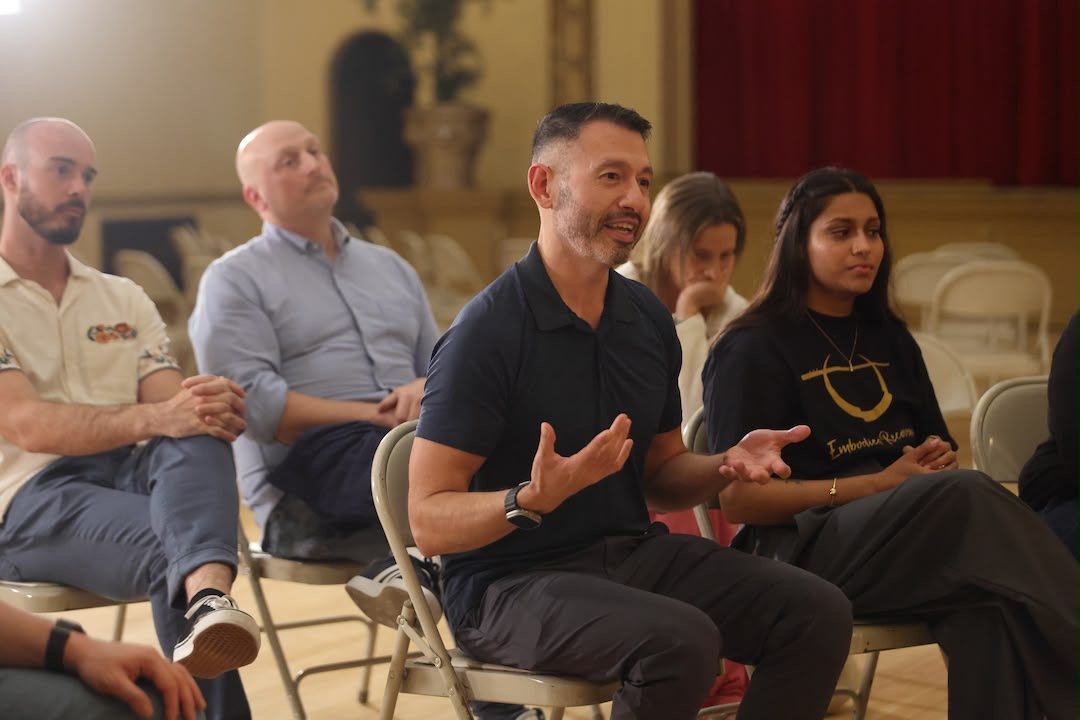
Juan Cortés speaking during an Embodied Recovery discussion on family, recovery and acceptance.
An evening with Embodied Recovery made me question a familiar role: family peacemaker.
In Summary
What does real intimacy ask of men? It requires honesty, vulnerability, acceptance, and the willingness to remain present when relationships are uncomfortable.
After attending an Embodied Recovery Empowered Living Teaching Series event about family, I began reconsidering my own complicated relationship with my family, the role I have played as its longtime peacemaker, and what it might mean to stop trying to change the people I love, and just start relating to them as they actually are.
A few weeks ago, I found myself sitting in the San Jose Women’s Club listening to a conversation about family.
It was part of Embodied Recovery’s Empowered Living Teaching Series, a monthly gathering exploring subjects related to recovery, healing, relationships, personal growth, and living a more connected life.
At one point, Michael began talking about his own family and about someone close to him who needed support in her recovery.
Something about the conversation struck a nerve.
I raised my hand.
The photograph accompanying this article captures that moment.
I asked about something that has been difficult for me for much of my adult life: my relationship with my family.
And I said something that was probably more vulnerable than I had intended to say publicly.
I admitted that I have often not wanted to be around them.
The Family We Have Versus the Family We Imagine
I am the youngest child in my family and the youngest son.
My family is of Mexican origin, and I am first-generation born in the United States. I grew up with two older sisters and, for reasons I am still trying to fully understand, I developed a powerful desire to leave home as soon as I could.
When I graduated from high school at 18, leaving felt like freedom.
Over the years, I encountered people, environments, ideas and ways of living that were different from those I had grown up around.
And somewhere along the way, I created an idea in my mind about the kind of family I wished I had come from.
Perhaps more sophisticated.
Perhaps wealthier.
Perhaps more intellectually curious.
Perhaps simply different.
That is difficult to admit.
But I think intimacy begins precisely there: with the truth.
Not the polished version of ourselves.
Not the version we think other people will approve of.
The truth.
During the Embodied Recovery conversation, I was encouraged to consider something both simple and surprisingly difficult:
What if I stopped judging my family for being who they are?
What if I stopped wishing they were different?
That question has stayed with me.
The Exhaustion of Being the Peacemaker
There is another part of my family experience that I have only recently begun to examine more seriously.
I have always felt like the peacemaker.
Even now, at 44 years old, I often feel responsible for smoothing things over, keeping everybody calm, preventing conflict, interpreting one family member to another, and maintaining some semblance of harmony.
Quite frankly, I am tired.
There can be something admirable about trying to create peace.
But there is also a danger in believing that peace is our responsibility to manufacture for everyone else.
For some men, this takes the form of being the provider.
For others, the protector.
The funny one.
The successful one.
The strong one.
The son who never causes problems.
The person who absorbs everybody else's emotions so nobody else has to.
Eventually, the role becomes an identity.
And identities can become prisons.
I am beginning to ask myself whether being a peacemaker sometimes prevented me from simply being a person within my family.
A person who is allowed to disagree.
A person who is allowed to leave the room.
A person who does not have to resolve every conflict.
A person who can love someone without taking responsibility for changing them.
That distinction feels important.
Why Family Can Become Especially Difficult During the Holidays
These questions become particularly relevant for me as the holidays approach.
Holiday gatherings are supposed to represent warmth, belonging and connection.
Sometimes they do.
Sometimes they also reactivate every old family dynamic imaginable.
You can spend decades developing into an independent adult and then walk through the door of your childhood family home and, within approximately fifteen minutes, find yourself emotionally transported back to being 16.
Old roles return.
Old frustrations return.
Old expectations return.
And old coping mechanisms can return too.
For me, alcohol was sometimes part of that equation.
There were occasions when drinking made it easier to participate, loosen up or feel as though I fit in with my family.
I stopped drinking about two years ago while dealing with diverticulosis and making substantial changes to my health and nutrition.
What began partly as a health decision also created an interesting psychological challenge:
If I am not going to numb or alter how I feel, then I actually have to experience how I feel.
That is a very different proposition.
And perhaps that is part of recovery in the broadest sense.
Not simply stopping a particular behavior.
Learning how to stay.
Men Are Very Good at Escaping
This question extends far beyond alcohol.
We live in an extraordinary age of escape.
Feeling lonely?
Pick up the phone.
Feeling anxious?
Scroll.
Feeling rejected?
Open an app.
Feeling sexually frustrated?
Pornography is available instantly.
Feeling uncomfortable with yourself?
There are virtually unlimited forms of stimulation waiting to make sure you never have to sit quietly long enough to find out why.
I do not say this from a place of judgment.
Quite the opposite.
I understand the temptation.
But I have become increasingly interested in a question that I believe will become central to Juan’s Journal:
What happens to men when our primary relationships become relationships with our devices rather than relationships with ourselves and other human beings?
We can become extraordinarily stimulated while remaining profoundly disconnected.
And stimulation is not intimacy.
What Real Intimacy Actually Requires
Real intimacy asks much more of us.
It asks us to be seen.
It asks us to listen when we would rather defend ourselves.
It asks us to tolerate moments of awkwardness.
It asks us to admit fear, disappointment, desire and uncertainty.
Sometimes it asks us to apologize.
Sometimes it asks us to forgive.
And sometimes it asks us to accept that another person may never become who we hoped they would become.
That last one may be among the hardest.
Because attempting to change another person can create the illusion that we remain in control.
Acceptance requires surrendering that illusion.
Acceptance does not mean approving of everything someone does.
It does not mean abandoning boundaries.
It does not mean tolerating abuse.
It does not require pretending that painful experiences were acceptable.
Acceptance means acknowledging reality before deciding how we want to relate to it.
This is the person standing in front of me.
This is my family.
This is what happened.
This is what I feel.
Now how do I want to live?
That is a much more powerful question than: Why can't these people finally become what I want them to be?
Maybe Intimacy Begins With Ourselves
I used to think intimacy primarily meant closeness with another person.
Increasingly, I think there is an earlier step.
We have to become intimate with ourselves.
We have to know what we actually feel before we can communicate it.
We have to notice when we are hurt rather than immediately converting hurt into anger.
We have to recognize loneliness before covering it with stimulation.
We have to understand why certain people activate something inside us.
And perhaps we have to become willing to meet parts of ourselves that we spent years avoiding.
Meditation has helped me with this.
Recovery communities have helped me with this.
Therapy has helped me with this.
Spiritual practice has helped me with this.
Writing certainly helps me with this.
I suspect I will spend the rest of my life learning it.
A Different Experiment This Holiday Season
So I am going to try something different this year.
When I am with my family, I want to practice three things:
Acceptance. Vulnerability. Honesty.
Acceptance means allowing my family members to be themselves without maintaining a running internal commentary about how they ought to be different.
Vulnerability means allowing myself to actually feel what happens inside me rather than immediately escaping, performing or fixing.
Honesty means recognizing my own limits and boundaries—including my commitment not to drink simply because doing so might make a gathering easier.
I am also giving myself permission to relinquish a job I never formally applied for:
family peacemaker.
I can contribute to peace.
I can behave lovingly.
I can communicate respectfully.
But I do not control whether everyone gets along.
Perhaps that distinction is part of growing up—even at 44.
The Stronger Man May Be the More Connected Man
We often associate male strength with independence.
And independence has tremendous value.
But I wonder whether our definition of strength has become incomplete.
Maybe strength also means having the emotional capacity to remain connected.
To ourselves.
To friends.
To partners.
To family.
To community.
To something larger than ourselves.
The stronger man is not necessarily the man who needs nobody.
Perhaps he is the man who no longer has to hide from himself.
The man who can tolerate vulnerability without interpreting it as weakness.
The man who can look at another imperfect human being and say:
I see who you are.
I know who I am.
I don't need either one of us to pretend.
And maybe, from there, something resembling real intimacy becomes possible.
I left the Embodied Recovery gathering that evening with more questions than answers.
That is usually a good sign.
Thank you to Greg and Michael, and to Embodied Recovery, for creating a space where conversations like these can happen.
One idea from that evening continues to follow me:
Can we learn to accept the people we love as they are instead of continually wishing they were different?
I don't completely know the answer yet.
But I intend to find out.